

Sometimes, You Just Need to Let Go

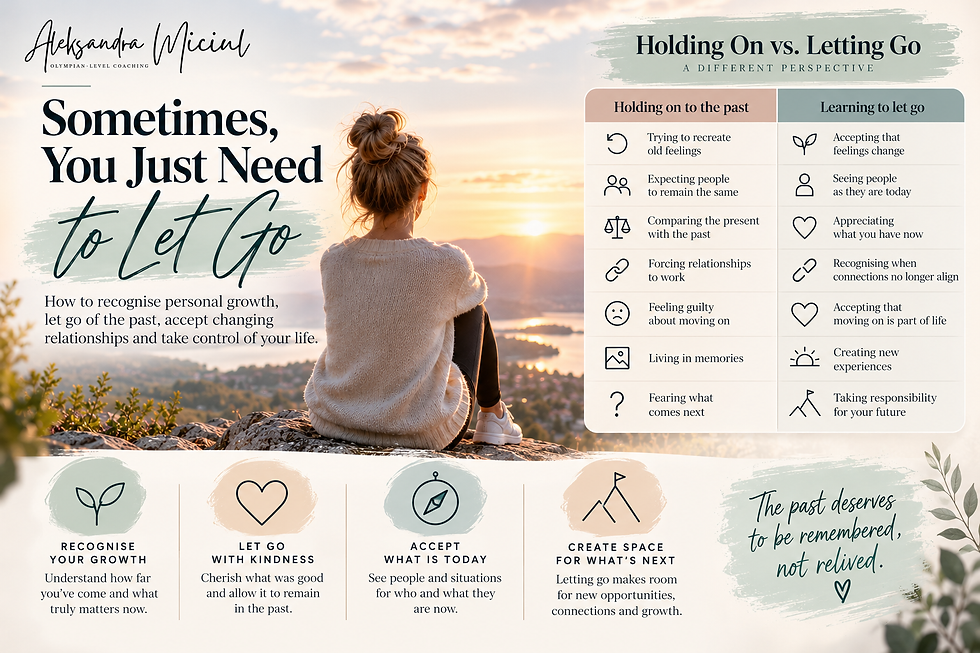
How to recognise personal growth, let go of the past, accept changing relationships and take control of your life.
In life, we are exposed to all kinds of challenges. Sometimes, life changes our direction. People and things we once thought meant everything to us, things we believed would stay by our side until our very last day, slowly begin to lose their meaning.
And then we start questioning ourselves.
Who changed? Was it them? Or did we simply open our eyes and finally begin to see what we had chosen to ignore for so long?
Is it personal growth? Or is it the growing distance between who we are becoming and what once felt so meaningful?
Perhaps it's a little bit of both.
Maybe you have no idea what I'm talking about. If so, perhaps this article isn't for you. However, if any of this sounds a little too familiar, read on.

People change. We change. Circumstances change. And our responsibility is to remain honest with ourselves about where we want to go, what we are willing to do to get there, and, most importantly, why it matters to us.
Understanding why certain situations no longer bring us joy is just as important as understanding why some people suddenly seem so different to us.
Sometimes, we desperately try to be our old selves again. We long to return to a time, a place, or a version of life that no longer exists. We hold on to memories, hoping that somehow we can recreate the feelings, connections and happiness we once experienced.
But here's something I'm about to tell you that you may need to hear, even if it's not necessarily what you want to hear:
Please leave the past in the past.
It had its time. It had its magic. It played its part in shaping who you are today. And there is nothing wrong with appreciating what once was.
But now, we are here.
And we owe it to ourselves, as well as to the people around us, to see things and people for who and what they are today, rather than through the lens of who or what they used to be.
Sometimes, moving forward means letting go
Sometimes, moving forward means accepting that something can have been wonderful once and still no longer belong in your present.
Growth often means recognising that certain connections no longer align with our values, our priorities or the direction in which we are heading.
And my best advice? Set them free. Let them go with love in your heart.
Cherish what was good, appreciate what those people and experiences brought into your life, and allow them to remain where they belong: in the past, as beautiful memories.
You see, when we try to bring the past into our present, desperately and sometimes forcefully attempting to make things fit where they no longer belong, we end up hurting ourselves. Not necessarily because something was wrong with what we had, but simply because its time has passed. Sometimes, moving forward means learning to establish boundaries without feeling guilty.
We cannot expect old connections to feel the same, people to remain the same, or situations to recreate emotions that once came naturally. And the harder we try to hold on to something that no longer aligns with who we are, the more we risk losing ourselves in the process.
Sometimes, we need to stop asking how we can make things work as they used to and start asking ourselves whether they still belong in our lives today.
Here is something worth thinking about:
Holding on to the past vs. learning to let go
Holding on to the past | Learning to let go |
Trying to recreate old feelings | Accepting that feelings change |
Expecting people to remain the same | Seeing people as they are today |
Comparing the present with the past | Appreciating what you have now |
Forcing relationships to work | Recognising when connections no longer align |
Feeling guilty about moving on | Accepting that moving on is part of life |
Living in memories | Creating new experiences |
Fearing what comes next | Taking responsibility for your future |
Sometimes, we don't even realise how much energy we spend trying to keep something alive simply because it once meant so much to us.
And here's another important thing: letting go doesn't mean rejecting your past.
Many people mistake letting go for giving up, but, in my opinion, nothing could be further from the truth.
Letting go is not about pretending something never mattered. It's not about erasing memories, dismissing shared experiences or suddenly deciding that something was never good enough.
It's about recognising that something can be meaningful without needing to be permanent.
It's about allowing yourself to appreciate what once was without feeling the need to recreate it.
Most importantly, letting go means no longer allowing your past to dictate your future.
You can be grateful for the people who once walked beside you without expecting them to continue walking with you. You can miss certain moments without wanting to go back. You can look back with a smile and still know, with absolute certainty, that you don't belong there anymore.
And perhaps that's what growing up and growing into yourself is really about.
Understanding that not everything we lose is a loss. Sometimes, it's simply life making room for something that better reflects who we are becoming.
So, don't hold on just because something once meant the world to you.
Let it have its place in your story. Honour it. Learn from it. And then give yourself permission to turn the page.
The past deserves to be remembered, not endlessly recreated. And your present deserves to be lived, not compared to what once was.
Now, let's talk about YOU.
Because here's the thing: letting go is not just about leaving certain people, situations or experiences behind. It's also about rediscovering yourself.
It's about re-evaluating who you really are, who you want to become and what kind of life you actually want to create for yourself.
And I want you to remember something:
You can take control of your life at any given moment.
It doesn't matter how old you are, how long you've been doing things a certain way or how many wrong turns you believe you've taken.
It all starts with a decision.
Interestingly, very often, it takes something quite painful to shake us up enough to finally make that decision. Sometimes it's emotional pain, sometimes financial difficulties, and sometimes even a physical experience that forces us to stop, take a step back and reconsider the direction in which we are heading.
It's almost as if life has been trying to get our attention for a very long time, but we haven't been listening.
If this is where you find yourself right now, I want you to do something.
Allow yourself to feel the pain.
Please don't immediately try to numb it with alcohol, distractions or anything else that helps you avoid dealing with what is really going on.
Feel it. Acknowledge it. Give yourself permission to experience it, at a pace that feels manageable.
I will repeat myself because I believe this is important: please understand, pain is communicating something to us. It is telling us that something needs attention, that a boundary has been crossed, that a situation is no longer sustainable or that we have been ignoring our own needs for far too long.
Perhaps you've simply been too busy with life to notice. Or perhaps, at some point, ignoring what you felt seemed more convenient than making a difficult decision and changing direction.
I understand. Change isn't always easy, and sometimes staying on a familiar path feels much safer than stepping into the unknown. But if you're hurting, perhaps it's time to start listening.
What is your body telling you? What is your mind trying to communicate? What have you been avoiding acknowledging?
And remember, pain doesn't always mean that you need to make an immediate or drastic change. Sometimes it means you need rest, support, a difficult conversation or simply time to understand what's happening.
The important thing is not to keep ignoring yourself.
It's about rediscovering yourself and becoming the person you want to be. How to Create Habits That Last: A Life Coach’s Guide to Lasting Change
A little exercise: reconnect with yourself in 30 minutes
I have a little exercise for you. Nothing complicated, nothing that requires special equipment. Just you, yourself and a little bit of quiet.
Find somewhere peaceful to sit. Ideally, somewhere in nature. Give yourself 30 minutes without distractions.
No phone. No music. No scrolling. Just you and your thoughts, with nature around you.
Start by observing what's happening around you.
Name three things you can see.
Name three things you can hear.
Name three things you can feel.
Take a deep breath in, and then an even deeper breath out.
Allow yourself to slow down.
And now, I want you to do something that might feel a little unusual.
Say sorry to yourself.
Yes, you read that correctly. Say sorry to yourself.
Think about how you would apologise to a friend if you hadn't been there for them when they needed you. Think about the compassion, understanding and kindness you would offer them.
Now offer yourself the same.
Perhaps you need to apologise for ignoring your feelings, for putting everyone else's needs before your own, for staying somewhere you knew you weren't happy, or for not having the courage to make a change sooner.
Whatever it is, acknowledge it. Say sorry, and allow yourself to accept that apology.
You don't need to punish yourself for the decisions you made in the past. You made them with the understanding, resources and emotional capacity you had at the time.
The important thing is that you're here now, and you have an opportunity to do things differently.
This small exercise is a way of reminding yourself that you are here for yourself. You are willing to listen, to pay attention and to take care of your own needs.
And if difficult emotions become overwhelming, it's perfectly okay to pause, seek support and return to this exercise when you feel ready. You don't have to work through everything alone.
Now, ask yourself a few important questions
Once you've allowed yourself a little quiet, start exploring what is going on inside.
Don't rush through these questions. Be honest. There are no right or wrong answers.
1. What is my mind telling me?
What keeps coming back to my thoughts? What am I struggling to accept? Is there something I've been avoiding acknowledging?
2. What would I like to change?
If I could change something about my current situation, what would it be? What no longer feels right?
3. Why is this change important to me?
What would it give me? How would my life look or feel different? What would I gain by making this change?
4. What can I actually do to change my current circumstances?
Think about practical steps, not just the big picture. What is within your control? What can you start doing differently?
And finally, the most important part:
Take the first step.
It doesn't have to be a huge decision or a life-changing action. It could be a conversation you've been avoiding, a boundary you've been meaning to establish, a new routine, asking for help or simply deciding that tomorrow you will do one thing differently.
Whatever it is, start somewhere.
You have got this.
And trust me, you will be just fine, even if things don't feel that way right now.
Remember, the actions you take today will have a direct impact on your life tomorrow, just as the actions you took (or didn't take) last year have had an impact on where you find yourself today.
You cannot change yesterday, but you can influence what tomorrow looks like.
So, be kind to yourself. Be honest with yourself. Stop trying to recreate a past that no longer exists, and start making room for the life you actually want to live.

A few things to remember when learning to let go
If there is one thing I'd love you to take away from this article, it's this:
You are allowed to outgrow situations, relationships and old versions of yourself.
You can appreciate your past without wanting to return to it.
Letting go doesn't mean that something wasn't important.
Personal growth starts with being honest about what you really want.
You don't need to wait for a crisis to make a positive change.
You can start again, even if all you can manage today is one small step.
You are not stuck. You are not too late. And you are not too far gone to start again.
Sometimes, all it takes is one honest conversation with yourself and one decision to change direction.
Take care of yourself, and remember that you deserve the same love, patience and understanding that you so freely give to others.
Frequently asked questions about letting go and personal growth
How do you know when it's time to let go of the past?
It may be time to let go when you find yourself constantly trying to recreate situations, relationships or feelings that no longer reflect your present reality. Letting go doesn't mean those experiences weren't valuable. It means accepting that your life has moved forward.
Does personal growth mean losing people?
Sometimes, yes. As we grow, our values, priorities and expectations can change. Some relationships naturally evolve, while others may no longer align with the direction we are taking. Growth doesn't mean abandoning everyone who changes; it means being honest about which connections remain healthy and meaningful.
How do you stop living in the past?
Start by recognising when you are comparing your present with memories of how things used to be. Practise accepting what has changed, reconnect with your current needs and focus on small actions that help you build the future you want.
How can emotional pain help you make positive changes?
Emotional pain can draw attention to unmet needs, difficult circumstances or situations that deserve closer examination. Rather than immediately distracting yourself, give yourself time to understand what you're feeling. If the pain feels overwhelming, seeking support from someone you trust or a professional can help.
How do you start taking control of your life again?
Start with one decision. Identify what you want to change, understand why it matters and choose one practical step towards that change. You don't need to have your entire future figured out before you begin.

A final word from me
If you've made it this far, perhaps something in this article resonated with you. Perhaps you're going through a period of change, questioning certain relationships or simply feeling that the life you once knew no longer feels quite right.
Whatever your situation, I hope you take a moment to listen to yourself.
You don't have to have all the answers today. You don't have to make every decision right now. But you do owe yourself the honesty to acknowledge what you feel and the courage to take the next step when you're ready.
And if there's one thing I'd love you to remember, it's that you don't have to keep living a life that no longer feels right simply because it's the life you've always known.
You deserve to create a life that reflects who you are today and who you want to become.
If you have any questions, or if something in this article resonates with you and you'd like to talk it through, please feel free to reach out. I'd be happy to help you find a way forward.
Chat soon,
Aleksandra


Comments